
AI Is Becoming Infrastructure, Not Software
AI is shifting from standalone tools to core infrastructure inside companies, reshaping how work is done, how systems are built, and what skills matter. This essay explores why the real bottleneck is no longer AI capability, but operational execution, workflow design, and organizational readiness.
CAREERSTARTUPS
Alexander Pau
5/16/20263 min read
AI used to feel optional
Not long ago, AI sat on the edge of work.
It was something you opened in another tab. A tool for drafting, summarizing, or experimenting. Useful, but separate from execution.
Companies added copilots into workflows and called it transformation.
Now that framing is breaking.
AI is no longer something you use.
It is something your work runs through.
That shift changes the questions companies ask:
Not “which AI tool should we adopt?”
But “what happens when this touches every workflow at scale?”
Not “can we use AI?”
But “can our systems absorb it?”
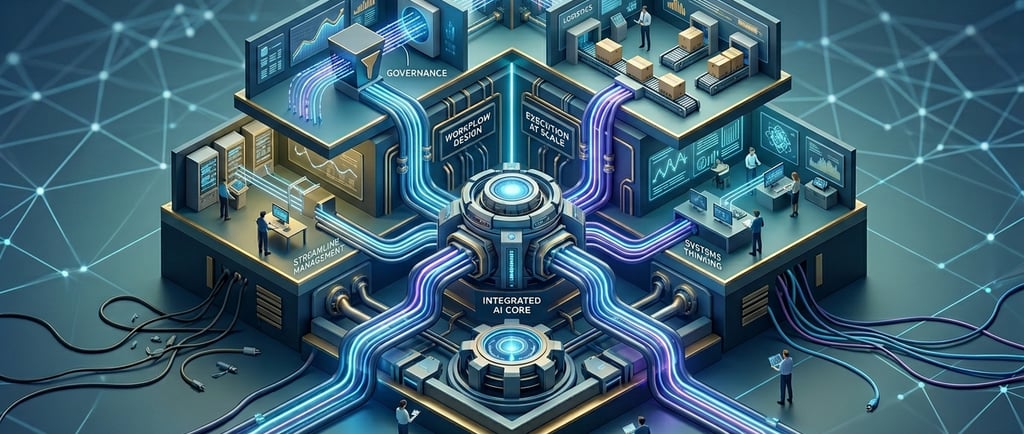
This is where AI stops behaving like software and starts behaving like infrastructure.
Related reading:
AI-native companies are reshaping careers
Infrastructure does not announce itself
You do not notice infrastructure when it works.
Nobody debates electricity during product planning.
Nobody rebuilds workflows around cloud hosting decisions anymore.
Infrastructure disappears because everything depends on it.
AI is moving into that same layer faster than most companies are prepared for.
The conversation is already shifting away from model comparisons and toward:
compute cost at scale
integration complexity
workflow reliability
governance and control
operational load
The Stanford AI Index highlights this shift clearly: progress is increasingly constrained by compute, infrastructure, and deployment limits rather than model capability alone. Stanford AI Index Report
The constraint is no longer intelligence.
It is execution at scale.
AI does not fix broken systems
This is where most companies misread what is happening.
AI is often treated as a shortcut around operational discipline.
But it does not remove friction.
It redistributes it.
Weak processes become faster weak processes
Unclear ownership becomes faster confusion
Messy workflows become scalable mess
The pattern is consistent:
A pilot works.
Leadership gets excited.
Rollout begins.
Then reality hits.
Not because AI failed, but because the system around it was never designed for this level of automation.
Related reading:
Tool sprawl is quietly killing startup execution
I have already seen this play out in smaller ways:
Multiple AI tools introduced into the same workflow.
No clear ownership of outputs.
Local optimization everywhere, global confusion everywhere.
The result is not efficiency.
It is operational noise at higher speed.
The real constraint is shifting
For most of software history, progress was limited by engineering capability.
With AI, that is no longer the main bottleneck.
The limiting factor is whether organizations can actually absorb what they are building.
This includes:
infrastructure capacity
workflow integration
data quality
governance structures
operational discipline
The McKinsey AI research consistently shows the same pattern: most organizations are still in early stages of scaling AI beyond experimentation into real operational systems. McKinsey AI insights
Even outside consulting research, the pattern is visible in enterprise reporting.
Axios highlights the growing gap between AI pilots and real deployment inside organizations. Axios AI implementation gap
That gap is where most of the friction lives.
Careers are changing in the same direction
This is not just a company-level shift.
It is a career-level one.
Tool knowledge used to be leverage.
Knowing specific systems or software gave you an edge.
That advantage is shrinking quickly.
Tools change too often now for that to hold.
What is becoming more valuable instead is systems thinking:
how work flows across teams
where breakdowns happen
how to reduce friction without adding complexity
how to operate inside ambiguity
Related reading:
AI made output cheap, judgment expensive
In other words:
You are no longer competing on tool knowledge.
You are competing on how well you understand systems under pressure.
What actually wins now
If you strip everything back, the pattern is simple.
Companies do not win AI adoption because they use more tools.
They win because their systems can handle what those tools produce.
The difference shows up in:
workflow clarity
ownership structure
decision speed under uncertainty
tolerance for operational chaos
Eventually, most companies will have access to similar AI capability.
The differentiator will not be access.
It will be execution stability.
Closing thought
AI is not becoming another software category.
It is becoming the environment software runs inside.
And once something becomes infrastructure, advantage shifts.
Not to the people who use it most.
But to the people who can design systems that still work when everything scales.
📚Further Reading
Stanford AI Index Report
A data-backed overview of global AI trends, including compute scaling, adoption limits, and infrastructure bottlenecks shaping the industry.
MIT Sloan Management Review – Artificial Intelligence
Research and case studies on why AI transformation fails more often from organizational design than from technology.
Harvard Business Review – Artificial Intelligence
Analysis of AI adoption inside real organizations, focusing on governance, leadership, and operational execution.
McKinsey QuantumBlack AI Insights
Enterprise research on scaling AI beyond pilots into production systems, and the structural barriers companies hit.
Reuters Technology – Artificial Intelligence
Ongoing reporting on AI adoption, regulation, labor impact, and real-world enterprise deployment trends.
OECD Artificial Intelligence Policy Observatory
Global policy and economic research on AI’s impact on productivity, labor markets, and long-term structural change.
TLDR
AI is shifting from tools people use to infrastructure companies depend on
The real constraint is no longer model quality, but operational and compute limits
Most AI failures come from workflow design, not technology
Companies that win will be those with clean systems, not the most tools
Career value is moving toward systems thinking over tool knowledge