AI-Native Companies Are Reshaping Careers Faster Than Most People Realize
AI is reshaping companies and careers by reducing layers of coordination work and rewarding high-leverage, cross-functional operators. This post breaks down what’s changing and what skills matter most in 2026.
STARTUPSCAREER
Alexander Pau
5/9/20266 min read
A few years ago, companies were hiring like growth would never slow down.
Entire departments got built around coordination. Teams grew fast. Layers multiplied. Startups raised massive rounds and scaled headcount before they even figured out sustainable operations.
Now the mood feels completely different.
This week alone, multiple tech companies tied layoffs and restructuring directly to AI-driven efficiency gains. Cloudflare announced layoffs affecting roughly 20% of staff while openly talking about AI productivity improvements, while Coinbase continued pushing toward becoming what it calls an “AI-native” company.
TechCrunch covered the Cloudflare story here:
https://techcrunch.com/2026/05/08/cloudflare-says-ai-made-1100-jobs-obsolete-even-as-revenue-hit-a-record-high/
The headlines make it sound like another typical tech layoff cycle.
I don’t think it is.
What’s happening right now feels more structural than temporary. Companies are not just trimming budgets anymore. They’re rethinking how work itself gets organized.
And honestly, I think a lot of people still underestimate how quickly this shift is happening.
The Real Shift Isn’t AI. It’s Leverage.
Most conversations about AI still focus on tools.
Which chatbot is best.
Which image generator is replacing designers.
Which AI startup just raised another billion dollars.
That stuff gets attention, but I don’t think it’s the real story.
The bigger shift is that companies are suddenly obsessed with leverage.
Founders are realizing smaller teams can move faster if the workflows are designed properly. AI is accelerating research, documentation, reporting, planning, and coordination. Work that used to require multiple people bouncing tasks between departments can now sometimes be handled by one strong operator with the right systems.
That changes hiring philosophy completely.
For years, startups were rewarded for growth at all costs. Bigger teams made companies look impressive. More meetings looked productive. More managers created the illusion of scale.
Now companies are asking a different question:
“How much output can this team create without adding more layers?”
That’s a very different operating environment.
There’s also growing research showing AI capability is quickly becoming a baseline business skill instead of some niche technical advantage:
https://arxiv.org/abs/2601.06500
You can already feel the shift happening inside companies.
The people becoming more valuable are usually the ones who can move between functions without needing constant direction. The operators who understand systems, communicate clearly, solve problems quickly, and actually execute are becoming force multipliers.
Meanwhile, a lot of purely coordination-heavy work is starting to look vulnerable.
Not because those people are untalented.
Because AI is getting very good at repetitive information movement.
A Lot of Corporate Work Was Built Around Translation
This is the uncomfortable part nobody really wants to say out loud.
A surprising amount of modern office work revolves around translating information between people.
Updating dashboards.
Summarizing meetings.
Writing project updates.
Formatting reports.
Relaying information between departments.
Creating documentation nobody reads.
AI happens to be extremely good at a lot of those tasks.
That doesn’t mean managers disappear tomorrow. It doesn’t mean humans stop mattering. But it does expose weak operational structures very quickly.
The managers who survive this shift will probably be the ones who reduce chaos instead of creating it. The people who can unblock teams, align stakeholders, simplify complexity, and make decisions under uncertainty become much harder to replace.
Execution is becoming visible again.
And honestly, that’s probably healthy.
For years, a lot of companies confused activity with progress. Entire teams became trapped in workflows that looked sophisticated but produced very little actual movement.
Ironically, many organizations are now responding by buying even more tools, which sometimes makes the problem worse.
More dashboards.
More disconnected software.
More AI subscriptions.
More noise.
I wrote about this problem recently in:
https://sharpstarts.com/tool-sprawl-is-quietly-killing-startup-execution-and-most-teams-dont-notice/
Because the reality is that bad operations don’t magically become good operations just because AI gets layered on top.
Sometimes AI simply accelerates dysfunction.
Career Pivoters Might Be Better Positioned Than They Think
This is the part I find most interesting.
For years, people were told the safest career strategy was deep specialization. Pick one lane. Stay in it. Become irreplaceable inside a narrow category.
I’m not sure that advice works the same way anymore.
The people I see adapting fastest right now are often the ones with nonlinear backgrounds.
The operators who worked across industries. The people who had to learn new systems repeatedly. The ones who survived uncertainty before AI became the dominant conversation.
Someone who moved from healthcare into tech often develops a completely different perspective than someone who stayed inside one function for fifteen years. Same thing with people who bounced between operations, customer-facing roles, analytics, project management, and strategy.
Those experiences build adaptability.
And adaptability suddenly matters a lot.
Because companies increasingly need people who can connect moving pieces instead of just managing one isolated function.
AI is increasing the value of technical leverage, but it’s also increasing the value of human translation. The people who can simplify complexity, align teams, and make practical decisions across departments are becoming extremely valuable.
That’s hard to automate.
Honestly, a lot of my thinking on this comes from surviving multiple pivots myself:
https://sharpstarts.com/how-i-survived-4-career-pivots-and-the-tools-that-actually-worked/
And I think many career pivoters underestimate how useful those experiences actually become in unstable environments.
AI-Native Doesn’t Mean Human-Free
One thing that keeps bothering me about the current AI conversation is how extreme everything sounds online.
Either AI will replace everyone tomorrow.
Or AI is overhyped and changes nothing.
Reality is probably somewhere in the middle.
The strongest people I know are becoming dramatically more effective because of AI. They’re writing faster, researching faster, automating repetitive work, and operating with far less friction.
At the same time, weak systems are getting exposed faster than ever.
You can already see companies drowning in low-quality AI-generated content, bloated workflows, and decision paralysis. Some teams are producing more output than ever while somehow becoming less effective.
Researchers and developers are increasingly warning about low-quality AI-generated output flooding workflows and creating review bottlenecks:
https://arxiv.org/abs/2603.27249
That point matters.
Because output is becoming cheap.
Judgment is becoming expensive.
That’s probably the biggest career shift happening underneath all the AI hype.
The people who stand out over the next few years likely won’t just be the people using AI tools. It’ll be the people who know when the output is actually useful.
That requires context. Communication. Prioritization. Decision-making.
Human skills are not disappearing.
They’re becoming more obvious.
The New Career Moat
I think a lot of people are still preparing for the future using old assumptions.
For a long time, career security came from specialization and predictability. Now the market seems to reward adaptability and execution much more aggressively.
The people building real leverage right now are usually the ones who:
learn quickly
operate across functions
communicate clearly
improve systems
understand business context
stay calm under uncertainty
Ironically, many of the so-called “soft skills” people ignored for years are becoming more valuable precisely because AI handles more technical repetition.
Companies still need people who can lead teams, simplify problems, and make judgment calls when things get messy.
And things always get messy eventually.
That’s also why I keep saying the future belongs to operators who can connect AI to real business outcomes instead of treating it like a novelty:
https://sharpstarts.com/how-to-align-ai-projects-with-real-business-goals-and-actually-deliver-results/
Because most companies do not actually have an AI problem.
They have an execution problem.
AI just exposes it faster.
Final Thought
I don’t think AI eliminates ambitious people.
But I do think it eliminates low-leverage work faster than most people expected.
That’s the real shift happening underneath the headlines.
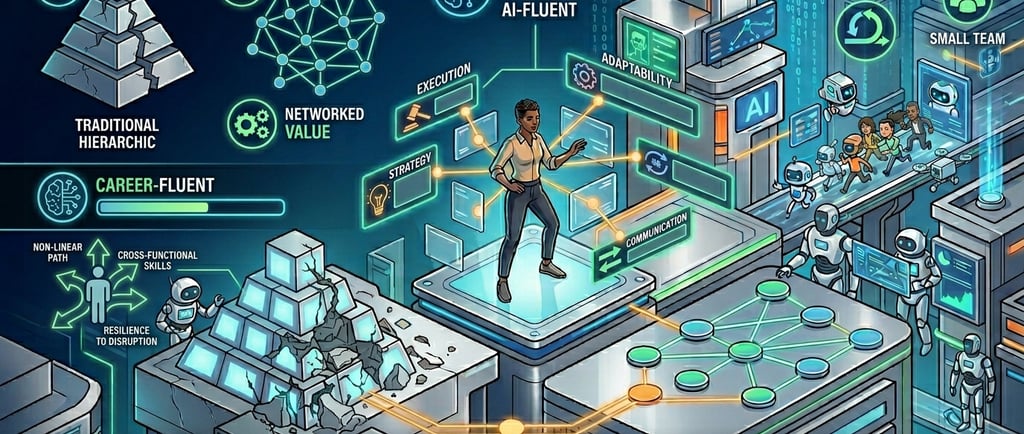
Companies are redesigning around smaller, faster, more adaptable teams. Coordination-heavy work is becoming vulnerable. Cross-functional operators are becoming more valuable. Career pivoters suddenly have advantages that didn’t matter as much before.
And honestly, I think a lot of unconventional backgrounds are about to age very well.
Because the future probably belongs to people who can learn quickly, move across systems, communicate clearly, and keep executing while everything else changes around them.
📚Further Reading
Microsoft Work Trend Index 2026 - Microsoft’s latest workplace research breaks down how AI agents are changing organizational structure, productivity, and the way teams operate.
Stanford AI Index Report 2025 - One of the best annual reports tracking AI adoption, investment, workforce impact, and global trends.
McKinsey: The State of AI - A practical look at how companies are actually implementing AI internally and where adoption is succeeding or failing.
The 2025 AI Agent Index - Research tracking how autonomous AI agents are beginning to reshape workflows and operational structures.
TechRadar on Microsoft’s “Transformation Paradox” - Interesting breakdown of why many companies struggle to actually transform despite heavy AI investment.
The AI Boom Is Consuming Historic Levels of Capital - A good perspective on the sheer scale of AI investment and why companies are under pressure to prove real productivity gains.
TL;DR
AI layoffs are not just cost-cutting anymore. Companies are redesigning how teams operate.
The biggest career risk in 2026 is being “task-replaceable,” not industry-specific.
Cross-functional operators are becoming more valuable than narrow specialists.
Career pivoters may actually have an advantage in the AI era.
The new moat is execution, communication, and systems thinking combined with AI fluency.