From Cleats to Companies: What FIFA 2026 Can Teach Us About Building Great Teams
Discover what FIFA 2026 teaches about teamwork, leadership, project management, and execution, and why great systems consistently outperform individual talent.
CAREERSTARTUPSLATEST
Alexander Pau
7/18/20265 min read
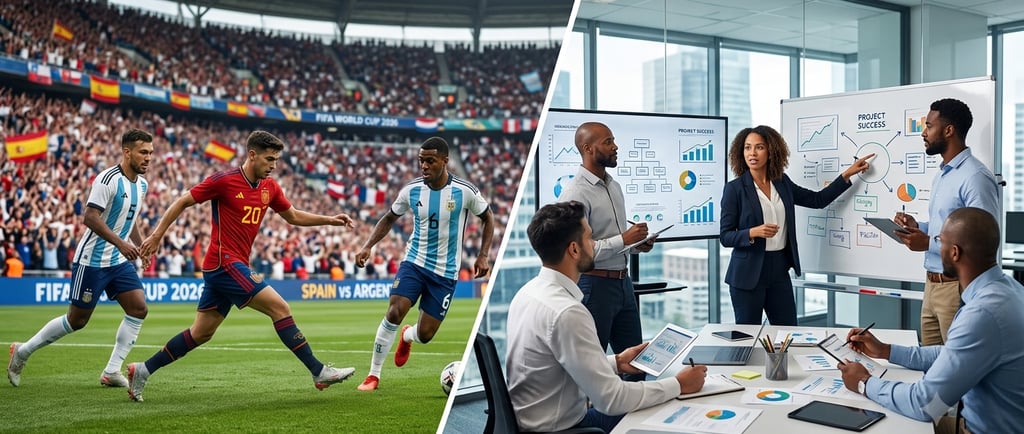

I have played soccer since I was a kid.
For as long as I can remember, soccer has been more than just a sport. It was where I learned some of my first lessons about teamwork, leadership, and dealing with pressure.
One thing became obvious pretty quickly: the best team was not always the one with the most talented players.
You could have a player who could dribble past everyone, someone with an incredible shot, or someone who was physically stronger than everyone else. But if the team did not communicate, if players did not understand their roles, or if everyone tried to do everything themselves, the result was usually chaos.
The teams that succeeded were the ones where everyone understood how their individual actions contributed to something bigger.
Years later, after working in business operations, project management, and analytics, I started noticing the same pattern in companies.
A struggling team at work often looks surprisingly similar to a struggling soccer team.
People are talented, but they are not aligned.
Everyone is busy, but nobody is moving in the same direction.
There are plenty of ideas, but nobody knows who owns the next decision.
That is why FIFA 2026 is such an interesting example.
When fans watch the World Cup, they see the final product: the goals, the celebrations, and the unforgettable moments.
But behind every match is one of the largest operational projects in the world.
The 2026 FIFA World Cup will be the biggest tournament in history, with 48 teams competing across Canada, Mexico, and the United States. FIFA World Cup 2026 Overview
What looks like a simple soccer match is actually the result of years of planning involving stadiums, transportation, security, technology, vendors, and thousands of people working behind the scenes.
The ninety minutes on the field are only possible because the entire organization behind it works.
And that is where businesses can learn something valuable.
Great teams do not rely on heroes
Soccer has always celebrated individual brilliance.
A moment of magic from a superstar can change a game. That is part of what makes the sport exciting.
But championships are rarely won by individuals alone.
A team cannot succeed if every player is trying to be the hero. A striker who never passes, a midfielder who ignores defensive responsibilities, or a defender who constantly leaves position may create exciting moments, but they also create problems.
Companies face the same challenge.
Many organizations hire talented people and assume talent alone will solve their problems. But without clear ownership, communication, and processes, even the smartest teams can struggle.
A great employee can solve a difficult problem.
A great team can solve difficult problems repeatedly.
That difference comes from having a system.
This is one reason why the best startups often operate more like soccer clubs than traditional companies. Everyone has a different position, but everyone understands how their role supports the team's overall strategy.
I wrote more about this idea in Why the Best Startups Operate More Like Soccer Clubs Than Tech Companies.
Clear roles create better execution
One of the things I love about soccer is how every position has a purpose.
The goalkeeper sees the game differently from the striker. A defender thinks differently from a midfielder. But the team only works when those different perspectives connect.
Business teams are no different.
A successful project requires people with different responsibilities. Someone needs to define the vision. Someone needs to manage execution. Someone needs to understand customer needs. Someone needs to build the solution. Someone needs to make sure the change actually works after launch.
The problem is not having different roles.
The problem is when those roles are unclear.
Many project failures are not caused by a lack of effort. They happen because people have different assumptions about who owns decisions and what success actually looks like.
Good project management creates alignment.
The Project Management Institute highlights how structured project practices help organizations manage complexity, stakeholders, and uncertainty. Project Management Institute
The best teams are not the ones where everyone does everything.
They are the ones where everyone knows what they are responsible for.
Preparation is what creates confidence
Professional soccer players do not become comfortable under pressure by accident.
They practice.
They review game footage.
They repeat situations until decision-making becomes instinctive.
Businesses often forget this lesson.
A company launches a new process but does not prepare employees.
A team starts a major project but does not align expectations.
A leader announces a strategy but does not explain how success will be measured.
Then everyone wonders why execution feels difficult.
Preparation is not about eliminating uncertainty. That is impossible.
Preparation is about building confidence when uncertainty arrives.
The best teams are not calm because pressure disappears.
They are calm because they know how to respond.
Adaptability separates good teams from great ones
Every soccer fan knows that a game rarely follows the original plan.
A team may score early. The opponent may change tactics. A player may get injured.
The best teams adjust without losing their identity.
Businesses face the same reality.
Markets change. Customers change. Priorities change.
The organizations that survive are not always the ones with the perfect plan.
They are the ones that can adapt when reality changes.
This is why operational clarity matters. Companies with clear processes and decision-making structures can respond faster because people understand how information moves and who needs to act.
This is also why process mapping is more than documentation. It helps teams understand how work actually happens.
I explored this further in Process Mapping Methodologies That Actually Drive Operational Clarity.
Chemistry is the hidden advantage
The greatest soccer teams are not simply collections of talented players.
They have chemistry.
Players understand each other's movements. They trust each other. They make decisions knowing their teammates will support them.
Companies need the same thing.
A team full of smart people is not automatically a high-performing team.
Trust matters.
Communication matters.
Shared purpose matters.
Research from Harvard Business Review Teams Collection has consistently shown that strong teams depend on collaboration, clarity, and the ability to work effectively together.
The strongest organizations are not built because everyone thinks the same.
They succeed because different people bring different strengths toward the same goal.
The final whistle
When FIFA 2026 begins, most people will remember the goals and the champions.
But behind every memorable moment will be thousands of people executing a plan.
That is the part that fascinates me.
The same principles that make a soccer team successful are the same principles that make organizations successful.
Clear roles.
Strong communication.
Trust.
Preparation.
Adaptability.
Whether you are building a startup, managing a project, or trying to advance your career, the lesson is the same:
Great teams are not built by finding the best individuals.
They are built by helping good people work together.
Further Reading
FIFA World Cup 2026 Official Website
Explore the official tournament information, host cities, schedules, and planning behind the largest FIFA World Cup ever held. It's a great example of coordinating a global event at an enormous scale.Project Management Institute (PMI)
PMI publishes practical guidance, research, and frameworks on project management, risk, stakeholder engagement, and organizational delivery that are relevant to projects of every size.Harvard Business Review – Teams
A collection of research and case studies on leadership, collaboration, psychological safety, and what separates high-performing teams from average ones.Atlassian Team Playbook
A practical library of workshops and exercises that help teams improve communication, retrospectives, decision-making, and collaboration.McKinsey: People & Organizational Performance
McKinsey's research explores organizational design, leadership, and operational excellence, with insights drawn from companies around the world.The Scrum Guide
The official Scrum Guide explains the Scrum framework and agile principles that many software and product teams use to organize work and continuously improve.
TL;DR
The biggest projects in the world succeed for the same reason great soccer teams do: everyone understands their role and works toward the same goal.
FIFA 2026 is not just a tournament. It is a massive coordination challenge involving countries, cities, businesses, and millions of people.
Talent can win moments, but systems win championships.
The best teams prepare for uncertainty instead of assuming everything will go according to plan.
Whether you are on a soccer field or leading a business, execution comes down to trust, communication, and teamwork.