The Entry-Level Job Is Being Rewritten Right in Front of Us
Entry-level jobs are being reshaped by AI, shifting from repetitive execution to judgment, communication, and problem-solving. Here’s what that means for new grads, career pivoters, and founders navigating the future of work.
CAREERSTARTUPS
Alexander Pau
6/22/20265 min read
TLDR
AI is changing the kind of work entry-level employees do, not simply eliminating jobs.
The traditional "learn by doing repetitive tasks" model is breaking down.
Companies increasingly value judgment, communication, and problem-solving over routine execution.
Career pivoters may have an unexpected advantage because they bring broader experience.
The future belongs to people who can interpret, challenge, and improve AI-generated output.
When I graduated from university, the career playbook felt pretty simple.
Get an entry-level role.
Learn the basics.
Do the repetitive work.
Slowly earn more responsibility.
Whether you became an analyst, project coordinator, marketer, consultant, or operations manager, most careers followed the same pattern. You started by executing tasks before eventually developing judgment.
Today, that sequence is starting to flip.
The biggest workplace story of 2026 isn't that AI is replacing jobs.
It's that AI is changing how people learn jobs in the first place.
And that shift could reshape careers far more than most people realize.
The Apprenticeship Model Is Quietly Breaking
For decades, organizations relied on a workplace apprenticeship model.
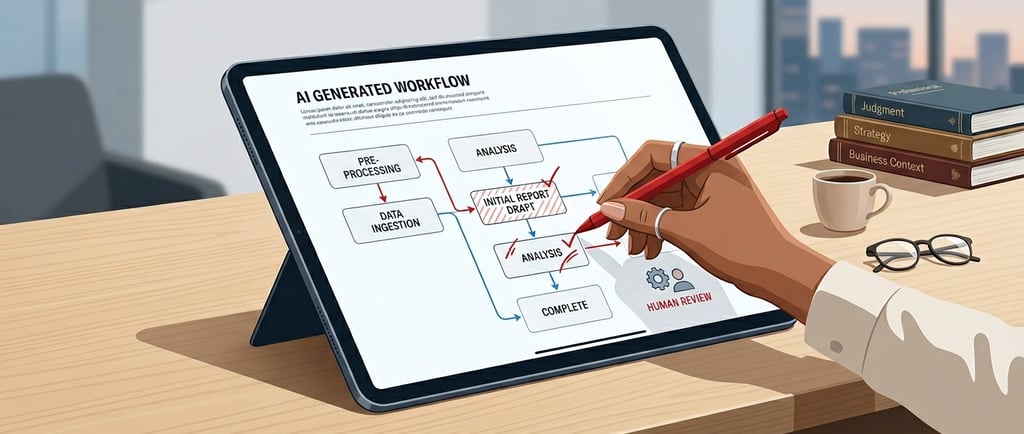
Junior employees created the first draft.
Senior employees reviewed it.
Over time, those junior employees learned how experienced professionals thought.
That's how analysts became strategists.
That's how coordinators became project managers.
That's how marketers became leaders.
The challenge is that AI is becoming surprisingly good at producing first drafts.
Meeting notes.
Research summaries.
Reports.
Content.
Presentations.
Even basic coding.
The very tasks that once helped people gain experience are increasingly being automated.
This trend reinforces an idea I explored in Why Generalists Are Winning in the Age of AI. When knowledge and execution become easier to access, the real value shifts toward connecting ideas, applying context, and making decisions.
The advantage moves away from simply doing the work and toward understanding what the work actually means.
Companies Want Judgment Earlier
One of the most interesting business stories this month wasn't about a new AI model.
It was about measurement.
A recent Reuters report on TD Bank's plan to introduce employee activity monitoring software sparked debate about workplace surveillance. Many people focused on privacy concerns, but the deeper signal is what this reveals about employers.
Organizations are trying to figure out how value is created in an AI-enabled workplace.
When software can generate reports, summarize meetings, and produce first drafts in seconds, traditional productivity signals become less useful.
Completing a report isn't necessarily impressive anymore.
Improving the report is.
The question increasingly becomes:
Can you identify flaws?
Can you challenge assumptions?
Can you make a recommendation?
Can you exercise judgment?
Those capabilities are much harder to automate.
The Experience Paradox
Here's where things get complicated.
Companies want employees who can think critically.
They want stronger decision-making.
They want business judgment.
But judgment is usually developed through experience.
And experience traditionally came from doing the repetitive work.
Now much of that repetitive work is being handled by AI.
So organizations are facing a strange paradox.
They want people to think like experienced operators earlier in their careers, but they're simultaneously removing some of the work that helped build that experience in the first place.
This is one reason I believe career pivoters may be better positioned than they think.
In How I Survived 4 Career Pivots and the Tools That Actually Worked, I wrote about how moving between industries forced me to adapt quickly. At the time, it felt like a necessity.
Today, adaptability is becoming a competitive advantage.
People who have worked across different environments often develop pattern recognition that can't easily be replicated by either AI or traditional career ladders.
Why Broad Experience Is Suddenly Valuable
For years, the prevailing advice was straightforward:
Specialize.
Stay in your lane.
Become an expert.
That advice still matters.
But AI is changing the economics of expertise.
When information becomes abundant, interpretation becomes scarce.
Someone who understands healthcare and technology.
Someone who understands operations and marketing.
Someone who understands customers and data.
Those combinations are becoming increasingly valuable.
That's why I argued in The Multi-Hat Survival Guide: How to Thrive When Job Titles Don't Match Reality that modern careers increasingly reward versatility. Startups have operated this way for years because they had no choice.
Now larger organizations are beginning to move in the same direction.
The future may belong less to specialists who know one thing deeply and more to operators who can connect multiple disciplines effectively.
Governments Are Seeing It Too
This isn't just a company-level trend.
Governments are paying attention as well.
Canada recently unveiled a new national AI initiative aimed at accelerating adoption and boosting economic productivity. According to Reuters' coverage of Canada's AI strategy, policymakers expect AI-driven growth to create significant economic opportunities over the coming years.
That sounds promising.
But there's a catch.
Technology adoption can happen much faster than workforce adaptation.
Teaching someone how to use AI tools is relatively easy.
Teaching someone how to make better decisions is much harder.
The skills gap many organizations face isn't necessarily technical.
It's operational.
It's contextual.
It's human.
The Skills AI Doesn't Replace
One of the more interesting findings from PwC's recent workforce analysis is that jobs most exposed to AI increasingly emphasize higher-order skills such as communication, judgment, leadership, and decision-making.
That shouldn't be surprising.
AI can generate options.
Humans still decide which option matters.
As a result, several skills are becoming more valuable than ever:
Problem Framing
Many people focus on solving problems.
Top performers identify the right problem to solve.
Communication
As information becomes abundant, clarity becomes scarce.
The ability to explain complexity simply is increasingly valuable.
Context Recognition
AI can provide answers.
Humans determine whether those answers make sense.
Decision-Making
Analysis creates possibilities.
Decisions create outcomes.
What This Means for New Graduates
If I were entering the workforce today, I wouldn't focus solely on standing out through technical skills.
I would focus on becoming useful in situations where AI struggles.
That means learning how to:
Communicate clearly
Navigate ambiguity
Build relationships
Understand business context
Make decisions with incomplete information
Ironically, many of these are the same skills that mattered before AI arrived.
The difference is that they're moving closer to the center of the hiring conversation.
What This Means for Founders
Founders face a different challenge.
Many organizations still train employees as though execution is the primary bottleneck.
Increasingly, it isn't.
The bottleneck is judgment.
The companies that win won't simply deploy better AI tools.
They'll build better systems for helping people learn how to think.
That's significantly harder than implementing software.
But it may become one of the most important competitive advantages of the next decade.
The Bigger Shift Nobody Is Talking About
The real disruption isn't the disappearance of entry-level jobs.
It's the disappearance of entry-level learning models.
For decades, people accumulated judgment through repetition.
Now much of that repetition is being automated.
That means individuals need to become far more intentional about acquiring exposure, context, and experience.
The future won't belong to the people who generate the most output.
AI is already making output abundant.
The future belongs to people who can evaluate output, challenge assumptions, and make better decisions.
The entry-level job isn't disappearing.
It's evolving.
And the people who recognize that shift early will be positioned to benefit from it.
📚Further Reading
https://www.weforum.org/reports/the-future-of-jobs-report-2025/ — Global outlook on workforce transformation and emerging skills.
https://www.mckinsey.com/featured-insights/future-of-work — Research on automation, productivity, and evolving work models.
https://hbr.org/topic/future-of-work — Leadership perspectives on managing changing workplaces.
https://www.oecd.org/employment/future-of-work/ — International research on workforce adaptation and skill development.
https://www.brookings.edu/topic/artificial-intelligence/ — Analysis of AI adoption, labor markets, and economic impacts.