
The Housing Crisis Is Becoming a Talent Crisis
Canada's housing market is cooling, but affordability is still reshaping hiring, retention, and career decisions. Here's what leaders need to know.
CAREERSTARTUPS
Alexander Pau
7/10/20265 min read
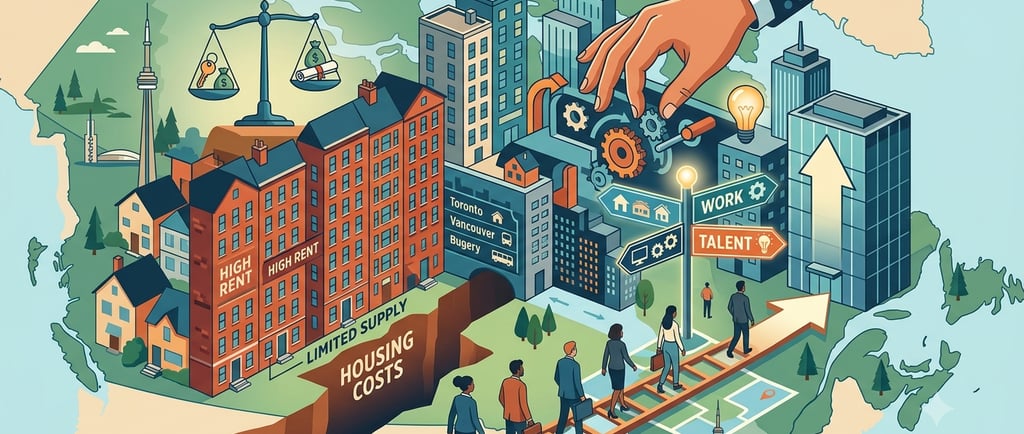
For years, housing affordability has been discussed as a personal challenge.
Can young professionals afford to buy a home?
Can families stay in the cities where they built their careers?
Can renters keep up with rising costs?
Recently, Canada's housing market has started to cool in many regions. Home prices have declined from their pandemic-era highs, inventory has increased, and buyers have gained more negotiating power.
On the surface, that sounds like good news.
But affordability remains a challenge.
A lower home price does not automatically mean housing is affordable again. Higher borrowing costs, elevated rents, and the overall cost of living continue to shape the decisions people make about where they live and where they work.
According to the Canada Mortgage and Housing Corporation (CMHC), housing affordability remains a major challenge across Canada, even as some markets begin to stabilize.
That's why this is no longer just a housing story.
It's becoming a business story.
A company can have an exciting mission, strong culture, and competitive salary. But if employees cannot realistically afford to build a life where that opportunity exists, companies are competing against more than just other employers.
They're competing against the cost of living itself.
The Hidden Business Problem Behind Housing Costs
Housing conversations usually focus on individuals.
But businesses are beginning to feel the ripple effects.
When employees make career decisions, they are not only thinking about:
Salary
Career growth
Company culture
Job responsibilities
They are also thinking about:
Where they can afford to live
How long their commute will be
Whether relocating makes financial sense
Whether a new opportunity improves their overall quality of life
This changes the traditional hiring equation.
For years, companies operated under the assumption:
Great opportunities attract great people.
But the reality is becoming more complicated.
A great opportunity only works if people can realistically accept it.
A candidate might love a company's mission and see a clear career path, but if taking the job means moving into a more expensive city or significantly increasing their living expenses, the decision becomes much harder.
Companies are no longer competing only with other employers.
They are competing with affordability.
Location Used to Be a Company Decision
For decades, companies decided where work happened.
They chose:
Office locations
Headquarters
Regional hubs
Employees adapted.
If someone wanted the opportunity, they moved closer.
That model worked when relocation was more accessible and housing costs were less restrictive.
Today, professionals are asking different questions:
Can I afford to live there?
Does the commute justify the opportunity?
Will this improve my life outside of work?
Does this align with my long-term goals?
Location is no longer just a company decision.
It is becoming a shared decision between companies and employees.
This shift changes how organizations think about talent.
The best candidate may not always be the person who lives closest to the office.
Why Startups Feel This Pressure the Most
Large companies often have advantages when competing for talent:
Strong brand recognition
Higher salaries
More established benefits
Greater job security
Startups compete differently.
They attract people through:
Ownership
Learning opportunities
Faster career growth
Meaningful work
But housing pressure changes that equation.
A startup asking someone to take a career risk becomes a harder decision when that person is also dealing with financial pressure.
This is why great startups need to think beyond recruiting.
Instead of asking:
"How do we find more candidates?"
They should ask:
"What barriers prevent talented people from joining us?"
Sometimes the answer is not better recruiting.
Sometimes the answer is redesigning how work happens.
Remote Work Is More Than a Productivity Debate
The remote work conversation often focuses on one question:
Are employees more productive at home or in the office?
But there is another question companies should consider:
How does workplace flexibility change access to talent?
Remote and hybrid work allow companies to expand their hiring pool.
Instead of asking:
Who can commute to our office?
Companies can ask:
Who has the skills we need?
The World Economic Forum Future of Jobs Report highlights how changing workplace models and economic pressures are reshaping how organizations think about talent.
Remote work is not just an employee benefit.
It is becoming a competitive advantage.
Companies that embrace flexibility can access talent that may have previously been unavailable because of geography.
Retention Matters More When Hiring Gets Harder
When hiring becomes more difficult, retaining great employees becomes even more important.
Replacing employees costs more than recruiting expenses.
Companies lose:
Institutional knowledge
Customer relationships
Project momentum
Team efficiency
This is why strong operational foundations matter.
Clear processes, better documentation, and effective communication help teams stay productive even when people change roles.
As I wrote in The Sharp Starts Tracking Playbook: How I Actually Keep Track of Things, systems are not about creating unnecessary bureaucracy.
They are about creating clarity.
Great companies do not rely on individual heroes.
They build systems that allow people to succeed.
What Companies Can Actually Do
Housing affordability is a complex issue, and businesses cannot solve it alone.
But companies can adapt.
1. Expand the talent pool
Hiring only from people who live nearby limits access to great candidates.
Skills, experience, and potential should matter more than geography.
2. Think beyond salary
Salary remains important, but employees evaluate opportunities based on the entire package:
Flexibility
Growth opportunities
Work environment
Long-term sustainability
3. Create stronger career paths
People are more likely to stay when they see a future inside the organization.
As discussed in The Multi-Hat Survival Guide: How to Thrive When Job Titles Don't Match Reality, adaptable employees are becoming increasingly valuable because modern roles rarely fit into one box.
4. Build better operating systems
Strong processes, communication, and leadership reduce unnecessary friction.
Retention is not just about compensation.
It is about creating an environment where people can do their best work.
The Career Lesson: Your Environment Matters
Professionals also need to rethink career decisions.
A job opportunity is no longer only about:
Salary
Title
Company reputation
It is also about:
Flexibility
Lifestyle
Financial sustainability
Long-term growth
A career decision is a life decision.
The highest-paying opportunity is not always the best opportunity.
The right opportunity is the one that creates the strongest overall position.
Final Thoughts
Housing affordability has traditionally been viewed as a personal issue.
But businesses are beginning to experience the consequences.
Where people can afford to live affects:
Where companies can hire
How teams are built
How employees make career decisions
How organizations grow
Even as housing prices cool in some markets, affordability remains a structural challenge.
The companies that recognize this shift will be better positioned to attract and retain talent.
Because the future of work is not only about where people work.
It is about where people can afford to build a life.
Further Reading
Canada Mortgage and Housing Corporation (CMHC) — Housing market data, affordability research, and insights into Canada's housing challenges.
Statistics Canada Labour Force Survey — Official data on employment trends, labour markets, and workforce changes across Canada.
World Economic Forum Future of Jobs Report — Research on how economic trends, technology, and workplace changes are reshaping employment.
OECD Housing Research — International research on housing affordability, supply, and economic impacts.
Harvard Joint Center for Housing Studies — Research on housing trends, affordability, and the connection between housing and communities.
McKinsey Global Institute: The Future of Work — Analysis of workforce transformation, changing employment models, and future talent strategies.
TL;DR
Housing affordability is no longer just a personal finance issue. It is becoming a business and talent challenge.
While housing prices have declined in many markets, affordability remains difficult because borrowing costs, rents, and everyday expenses are still elevated.
Companies can no longer assume great candidates will relocate simply because the opportunity is attractive.
Remote and hybrid work are becoming strategic tools for accessing talent, not just employee perks.
The companies that rethink hiring, retention, and workplace flexibility will have an advantage in the next era of work.