
When AI Spending Isn’t Enough: What the Market’s 2026 Reset Means for Leaders and Careers
A grounded look at how AI spending, layoffs, and investor pressure are reshaping startups and careers in 2026 — and what operators can do to stay relevant.
STARTUPSCAREER
Alexander Pau
2/1/20264 min read

1️⃣ The Market Isn’t Impressed
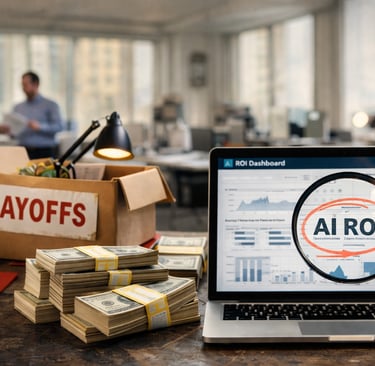
Microsoft spent hundreds of millions on AI. Investors yawned. Meta rolled out measurable growth and got a high-five from Wall Street. The takeaway is brutal: spending money on AI is meaningless without results.
“In late January 2026, markets punished some of the biggest AI spenders while rewarding those showing tangible revenue growth.”
(Reuters/Finance)
From my own experience, I’ve seen teams buy expensive tools and assume adoption happens automatically. The dashboards sit there, pretty graphs and charts, but no one is actually acting on them. That’s what investors see — money spent, no impact. It doesn’t matter how shiny the tech is. Outcomes are the only thing that counts.
This is exactly why I wrote How to Align AI Projects With Real Business Goals (and Actually Deliver Results). AI without decision context is decoration. You can’t measure ROI if no one uses the output to influence a decision that changes the business.
The key lesson for operators and career pivoters: don’t chase tech for the sake of tech. Chase outcomes. Ask yourself: “What does this AI change tomorrow?” If you can’t answer that, it’s already failing.
2️⃣ Layoffs Aren’t a Coincidence
Amazon cut 16,000 jobs in January. Peloton trimmed 11% of its staff days after launching AI hardware. Over 22,000 tech jobs disappeared in total.
“Mass layoffs — including 16,000 announced by one major firm — underscore that workforce restructuring remains part of how companies are trying to fund and integrate AI.”
(Reuters)
“More than 22,000 tech jobs were cut in January alone, with several employers attributing these changes to efficiency priorities as they accelerate AI adoption.”
(NewsBytes / Indian Express)
This is more than numbers. It’s a warning: efficiency isn’t free. Teams are being reshaped so AI can be integrated and funded. It’s messy. It’s human. And if you’re not tracking actual outcomes, your team is quietly wasting both talent and capital.
I’ve seen startups hire AI engineers and data scientists without thinking about who would actually act on the insights. The result? A small army of highly paid analysts creating dashboards no one uses. The company doesn’t see ROI. Investors notice. Layoffs follow.
The people who survive aren’t just “smart”, they’re adaptable, multi-hat operators. That’s why The Multi-Hat Survival Guide is still so relevant. In a world where job titles don’t match responsibility, owning outcomes is the difference between surviving a layoff and getting washed out.
3️⃣ Tools Don’t Fix Broken Workflows
Here’s a hard lesson: AI doesn’t fail because it’s bad. It fails because no one acts on it.
I’ve seen the same mistakes over and over:
AI dumped into broken workflows
Metrics with no owner
Dashboards that gather dust
No meeting where AI changes a decision
A real-world example: a mid-sized company implemented a fancy forecasting tool. They had 3 analysts assigned to it. Everyone loved the dashboard, but no one had the authority to stop a product launch, adjust marketing spend, or change inventory based on its output. Six months later, the tool was “live,” but decisions hadn’t changed. The result? The CFO canceled the contract. Wasted time, wasted money.
This is why Power BI + OKRs works. It’s not the tool, it’s the operating rhythm: weekly reviews, owned metrics, clear decisions tied to outcomes. When done right, a dashboard becomes a lever, not decoration.
4️⃣ Winners Measure the Right Things
Companies that succeed with AI do it differently:
Pick one value stream first (sales, ops, support)
Define a simple before/after metric
Embed AI output into actual decisions
Review results weekly, not quarterly
The difference between success and failure is often who owns the number. If no one’s accountable, nothing happens.
AI doesn’t replace people. It changes what people argue about — priorities, speed, revenue. It surfaces where decisions are stuck. It doesn’t fix indecision, but it exposes it.
5️⃣ Your Operator Checklist
Before green lighting AI spend, answer these five questions:
What decision actually gets faster or better?
Who owns the metric?
Where does it show up weekly?
What do we stop doing if it works?
How will we know in 90 days if it fails?
If you can’t answer in a sentence, it’s theater. And theater is expensive. Investors see it. Your team feels it. Layoffs eventually follow.
Execution beats vision every single time.
6️⃣ Why This Matters
Founders: Stop chasing shiny AI toys. Redesign decisions. Start with one workflow and prove outcomes before scaling.
Operators: Translate AI into execution. Own a metric, influence decisions, and make the tools matter.
Career Pivoters: AI skills alone don’t pay. Business judgment, systems thinking, and the ability to drive results do.
I’ve been in roles where the “AI solution” looked amazing on paper but produced nothing. I’ve also seen teams with zero AI budget crush results because they had clarity, ownership, and action. That’s what matters.
In 2026, AI isn’t a differentiator. Execution is.
📚Further Reading
Investors punish big tech AI spending that delivers slower growth
How the market is shifting from hype to measurable business outcomes when it comes to AI investment. (AOL)
Amazon cuts about 16,000 corporate jobs in latest round of layoffs
A major example of workforce restructuring alongside AI efficiency pushes. (AP News)
Pinterest lays off hundreds, citing need for ‘AI-proficient talent’
Another tech company publicly shifting roles and priorities toward AI. (SFGATE)
Layoffs.fyi tracks layoffs across the tech industry
A useful resource on global tech layoffs data — helpful for deeper context. (Wikipedia)
Tech layoffs linked to AI adoption and restructuring
Analysis of widespread job cuts tied to AI integration and operational shifts. (Digital Journal
TL;DR
Dumping money into AI doesn’t guarantee results. Investors are punishing companies that can’t show real outcomes.
Layoffs are happening alongside AI pushes — efficiency is expensive.
Execution beats tools. If your team can’t act on it, AI is just noise.
Winners embed AI into decisions that actually move the business.
If leadership can’t summarize AI ROI in a sentence, it’s probably a theater project.