
Why Modern Teams Optimize Tools Instead of Fixing Workflows
Most teams don’t fail because they lack tools, they fail because they keep optimizing software instead of fixing broken workflows. In 2026, the real bottleneck is how work flows through systems, not the tools used to manage it.
CAREERSTARTUPS
Alexander Pau
5/31/20263 min read

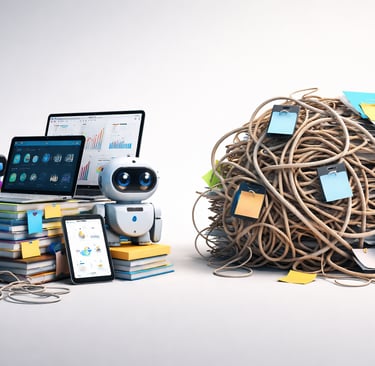
We’ve entered a strange phase of work.
If something feels inefficient, the default response is no longer “fix the process.”
It’s:
add a tool
automate a step
plug in AI
spin up a dashboard
It feels productive.
But most of the time, nothing actually changes underneath.
1. Tools are visible. workflows are invisible.
This is the core reason everything tilts toward tooling.
Tools are:
easy to buy
easy to demo
easy to roll out
easy to justify in a Slack message
Workflows are the opposite.
Fixing a workflow means:
changing how people make decisions
redefining ownership
removing steps someone already likes
confronting ambiguity
That’s slow. And uncomfortable.
So teams pick the visible fix instead of the real one.
This is exactly how you end up with systems that look modern but behave like legacy operations.
Related breakdown: Tool Sprawl Is Quietly Killing Startup Execution
2. AI made this worse, not better
AI didn’t create the tool problem.
It just made it faster.
Now instead of:
“should we improve this process?”
Teams jump straight to:
“can AI handle this step?”
So instead of fixing workflow friction, they layer intelligence on top of it.
That creates a new pattern:
same broken process
faster output
more downstream confusion
This shows up clearly in posts like AI agents aren’t failing, your operations are, where the issue isn’t capability, it’s system design.
AI didn’t remove workflow thinking.
It just made it easier to skip it.
3. Tooling feels like progress because it produces artifacts
There’s a psychological reason this keeps happening.
Tools produce things you can see:
dashboards
automations
integrations
reports
AI outputs
Workflows don’t.
A better workflow often looks like… nothing changed.
Same people. Fewer steps. Less noise.
So ironically:
visible change = perceived progress
invisible improvement = underestimated value
That mismatch drives most “transformation” failures.
Even large-scale research from Gartner consistently shows that adoption complexity and process integration are the real blockers, not lack of tools.
4. Teams avoid workflow decisions because they are political
Here’s the uncomfortable part.
Fixing workflows is not a technical problem.
It’s a human one.
Because it forces questions like:
who owns this step now
who loses control if we remove this
who has to change how they work
what do we stop doing
Tools avoid those questions.
That’s why they win by default.
It’s easier to add software than to renegotiate how work actually flows.
A pattern I keep seeing
A team I worked around recently introduced multiple AI and productivity tools across their workflow:
AI note-taking
automated reporting dashboards
task generation inside project management tools
internal knowledge assistant
On the surface, everything looked “modernized.”
But the underlying workflow stayed untouched.
So what happened?
Instead of fewer steps, they had:
the same approvals
the same unclear ownership
more places where work could be updated
more confusion about what was “latest”
One manager summed it up:
“We made everything faster, but somehow nothing became clearer.”
That’s the tool trap.
5. Workflow fixes feel slower, but compound more
A real workflow fix usually looks unglamorous:
removing steps instead of adding them
consolidating decision points
reducing handoffs
clarifying ownership
eliminating redundant systems
No flashy output.
But massive downstream impact.
This is where execution systems actually improve, like in how dashboards turn into decisions instead of noise.
The irony is:
tools create short-term speed
workflows create long-term leverage
Most teams pick the first.
6. The real shift happening right now
We’re slowly moving from:
“What tools should we use?”
to:
“What steps in this workflow should not exist at all?”
That second question is harder.
But it’s where real leverage is.
Because in most teams, the problem isn’t missing tools.
It’s unnecessary work that no one has challenged in years.
Closing thought
Modern teams don’t stall because they lack technology.
They stall because they keep upgrading tools instead of redesigning how work flows through the system.
Tools are easy.
Workflows are honest.
And honesty is what most systems avoid.
The companies that win in the next phase won’t be the ones with the best stack.
They’ll be the ones willing to delete steps instead of optimizing them.
📚Further Reading
Harvard Business Review: Why workflows matter more than tools
Why process redesign beats incremental tool upgrades.MIT Sloan: Digital transformation failures
Real reasons transformation projects stall in execution.McKinsey on organizational design
How structure and workflow design impact performance.Gartner IT research
Enterprise insights on tooling complexity vs productivity.Atlassian Work Management insights
How teams actually structure modern workflows.Stanford Digital Economy Lab
Research on productivity, systems, and modern work design.
TLDR
Teams often add tools instead of fixing broken workflows
Tooling feels like progress because it’s visible and fast
Real workflow fixes are slow, political, and uncomfortable
AI is accelerating tool adoption, not workflow redesign
The real constraint is decision-making, not software