Why the Best Startups Operate More Like Soccer Clubs Than Tech Companies
Discover why the best startups operate more like soccer clubs, using role clarity, coaching, team development, and resilience to drive consistent execution.
CAREERSTARTUPS
Alexander Pau
6/8/20266 min read
TLDR
Most startups spend too much time chasing talent and not enough time building systems.
Soccer teams win because players understand their roles and trust the system.
Great leaders act more like coaches than heroes.
Developing people is usually more effective than constantly replacing them.
AI can improve execution, but it can't replace trust, chemistry, and teamwork.
A few summers ago, I played on a soccer team that looked great on paper.
We had speed. We had skill. We had players who could beat defenders one-on-one. If you watched us warm up, you'd probably assume we were one of the strongest teams in the league.
Then the game started.
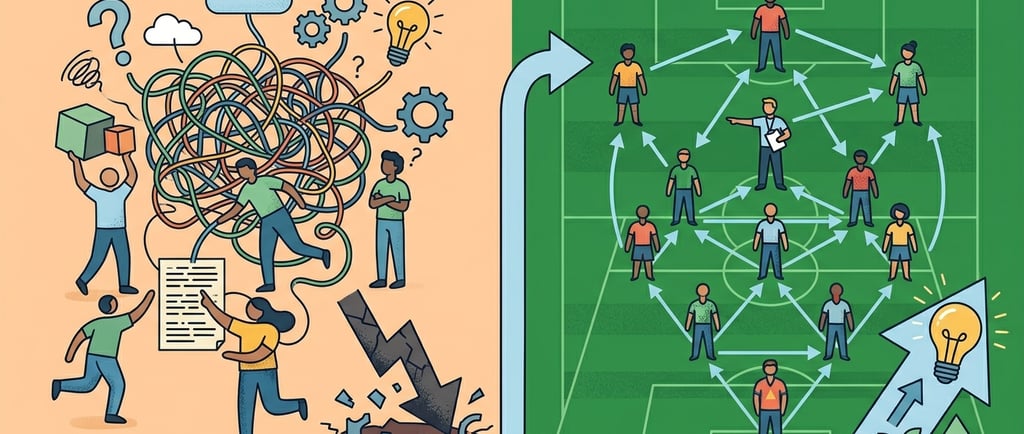
Our defenders pushed too far forward. Midfielders drifted out of position. Everyone wanted to be the hero. Every attack looked improvised. Every mistake created another scramble.
We lost.
Afterward, nobody could understand why.
The reality was simple: we weren't actually a team. We were a collection of individuals wearing the same jersey.
Over the years, I've seen the exact same thing happen inside startups.
A company hires talented people. It buys the latest software. It invests in AI tools. Everyone is smart, motivated, and capable.
Yet somehow projects stall, priorities become fuzzy, and execution feels harder than it should.
When leaders encounter this problem, they often assume they need more talent.
What they actually need is a better system.
That's why I've come to believe that great teams look a lot more like soccer clubs than startups.
The Startup Myth: Just Hire Better People
One of the most common startup assumptions is that every organizational problem can be solved by hiring someone exceptional.
Need more growth?
Hire a better marketer.
Need more sales?
Hire a top-performing account executive.
Need better execution?
Bring in a project manager.
Sometimes this works. More often, it creates a different problem.
A team made entirely of stars doesn't automatically become a championship team.
Soccer figured this out decades ago.
The world's best clubs don't simply collect talented players and hope everything works itself out. They spend enormous amounts of time defining responsibilities, building systems, practicing communication, and ensuring players understand how they fit together.
As highlighted in a well-known Harvard Business Review article on teamwork, high-performing teams succeed because of collaboration, clarity, and coordination, not just individual brilliance.
https://hbr.org/2016/06/the-secrets-of-great-teamwork
This lesson is surprisingly difficult for startups to learn.
When growth slows, many organizations immediately look outside for solutions.
When execution breaks down, the root cause is often inside the system itself.
No amount of hiring can compensate for unclear priorities, poor communication, or lack of ownership.
Every Player Has a Position
One reason soccer works as such a powerful team sport is because every player has a role.
A goalkeeper isn't expected to score goals.
A striker isn't expected to organize the back line.
A winger isn't responsible for every defensive assignment.
Everyone understands where they contribute.
The best teams don't eliminate specialization. They coordinate it.
Startups frequently struggle with this concept.
In early-stage companies, wearing multiple hats is often necessary. I've done it myself throughout my career, moving between healthcare, operations, startups, project management, analytics, and marketing.
The challenge appears when temporary flexibility becomes permanent ambiguity.
I've sat in meetings where five intelligent people discussed the same issue for an hour, only for nobody to leave knowing who owned the next step.
The issue wasn't competence.
The issue was clarity.
When ownership is unclear, work slows down.
When responsibilities overlap excessively, accountability disappears.
When everyone owns something, nobody truly owns it.
This is one reason process design matters more than most organizations realize.
I wrote previously about how effective process mapping creates operational clarity. Teams move faster when they understand how work flows through the organization and who is responsible at each stage.
https://sharpstarts.com/process-mapping-methodologies-that-actually-drive-operational-clarity
Just like soccer teams rely on formations and defined responsibilities, organizations need structure that helps people work together effectively.
Great Coaches Build Systems, Not Heroes
Growing up, I assumed great coaches were tactical geniuses.
As I've gotten older, I've realized something different.
The best coaches are often exceptional system builders.
They create environments where players know what success looks like.
They establish expectations.
They create accountability.
They develop trust.
Most importantly, they help people perform better together than they would individually.
The same principle applies to leadership.
Early in my career, I thought leaders were supposed to have all the answers.
Now I think great leaders spend less time being the smartest person in the room and more time helping the room function effectively.
That's one reason I've become such a strong believer in servant leadership.
The best leaders remove obstacles, align priorities, and create conditions where teams can succeed.
They don't try to score every goal themselves.
They coach.
I explored this idea in more depth in my article on servant leadership, but the core lesson remains simple: leadership isn't about being the hero. It's about building a system that doesn't require one.
https://sharpstarts.com/why-servant-leadership-is-the-only-kind-that-actually-works
The Best Clubs Invest in Development
Elite soccer clubs understand something many startups forget.
Talent isn't just acquired.
It's developed.
The most successful clubs spend years investing in youth academies, coaching systems, and player development programs.
They don't rely exclusively on buying talent.
They create talent.
Startups often take the opposite approach.
When performance slips, the instinct is to hire someone new.
When growth slows, the instinct is to recruit another expert.
When challenges emerge, the instinct is to search externally for solutions.
Sometimes that's necessary.
But organizations that constantly replace people instead of developing them create a fragile culture.
I've experienced multiple career pivots throughout my own professional journey. Each transition required learning new skills, adapting to new environments, and becoming comfortable being uncomfortable.
Those experiences reinforced a simple truth:
People can grow far more than most organizations expect.
When companies invest in onboarding, coaching, documentation, mentorship, and learning opportunities, they often unlock performance that would never appear on a résumé.
That's one reason development remains one of the highest-return investments any leader can make.
https://sharpstarts.com/how-i-survived-4-career-pivots-and-the-tools-that-actually-worked
Championship Teams Have Depth
Every soccer season eventually tests depth.
Injuries happen.
Players miss games.
Schedules become congested.
Unexpected challenges emerge.
The teams that survive these moments aren't always the most talented.
They're the most resilient.
Business works the same way.
A single employee departure shouldn't bring operations to a halt.
A vacation shouldn't create organizational panic.
Critical knowledge shouldn't exist exclusively inside one person's head.
Organizations that depend on a handful of heroes create enormous operational risk.
Organizations that distribute knowledge create resilience.
This idea becomes even more important as businesses adopt AI, automation, and increasingly complex technology stacks.
According to McKinsey's research on organizational resilience, companies that build adaptability into their operations consistently perform better during periods of uncertainty and disruption.
https://www.mckinsey.com/featured-insights/mckinsey-explainers/what-is-resilience
In other words, resilience isn't just a defensive strategy.
It's a competitive advantage.
AI Still Can't Build Chemistry
AI has become one of the biggest conversations in business.
For good reason.
AI can generate content.
AI can summarize meetings.
AI can automate workflows.
AI can help teams move faster.
But there is one thing AI still struggles to replicate.
Chemistry.
Anyone who has played competitive sports understands this immediately.
You can't measure trust with a dashboard.
You can't automate relationships.
You can't prompt-engineer genuine teamwork.
The strongest teams often develop an intuitive understanding of one another. Players anticipate movement. Teammates communicate without speaking. People trust each other during difficult moments.
Google's extensive research into team effectiveness found that psychological safety consistently plays a major role in high-performing teams.
https://rework.withgoogle.com/en/guides/understanding-team-effectiveness/
Technology can support execution.
It cannot replace human connection.
As AI becomes more capable, this distinction becomes more valuable, not less.
The future won't belong to organizations that simply adopt the most tools.
It will belong to organizations that combine technology with strong cultures, clear systems, and effective teamwork.
Final Thoughts
The best soccer clubs aren't built around stars.
They're built around systems.
The players matter. The talent matters. The technology matters.
But none of those things matter as much as the ability to work together.
Too many startups spend their time searching for heroes.
Great teams focus on roles, development, communication, resilience, and trust.
That's what soccer clubs have understood for years.
And it's a lesson more startups would benefit from learning.
Because at the end of the day, success isn't usually determined by the strongest individual on the field.
It's determined by the team that plays together the best.
📚Further Reading
The Culture Code by Daniel Coyle
A practical look at how successful groups build trust, belonging, and long-term performance.
https://danielcoyle.com/the-culture-code/
Team Topologies
A modern framework for designing teams that scale effectively as organizations grow.
https://teamtopologies.com/
The Five Dysfunctions of a Team by Patrick Lencioni
One of the most influential books on why teams struggle and how leaders can improve performance.
https://www.tablegroup.com/product/the-five-dysfunctions-of-a-team/
Measure What Matters by John Doerr
The book that popularized OKRs and explains how alignment drives execution.
https://www.whatmatters.com/book
The Advantage by Patrick Lencioni
A compelling argument that organizational health is one of the most underrated competitive advantages.
https://www.tablegroup.com/product/the-advantage/
TLDR
Most startups spend too much time chasing talent and not enough time building systems.
Soccer teams win because players understand their roles and trust the system.
Great leaders act more like coaches than heroes.
Developing people is usually more effective than constantly replacing them.
AI can improve execution, but it can't replace trust, chemistry, and teamwork.