
Your SQL Isn’t Messy, It’s Lying: How Bad Grain and Weak OKRs Kill Execution
Learn how bad SQL grain and weak OKRs silently break execution. Discover practical tips for data modeling, metrics you can trust, and operator‑grade systems that turn dashboards into action.
CAREERSTARTUPS
Alexander Pau
1/11/20265 min read

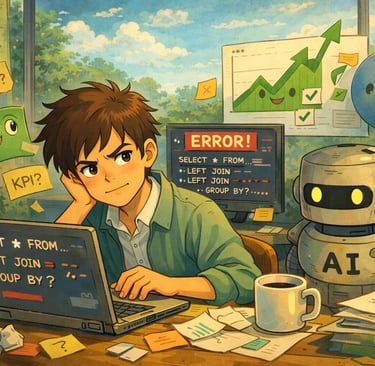
Every analytics team has that model.
The one that technically works,
the one nobody wants to touch,
the one leadership still trusts because the numbers look right.
Six joins deep, three nested subqueries, a GROUP BY at the end that feels more like a prayer than design.
It does not crash, it just slowly detaches from reality.
That is how your OKRs start missing even when dashboards look healthy.
Grain: The Line of Code You Never Write Down
Grain is not academic, it is the answer to one sentence:
One row in this table represents exactly one ____ (you fill in the blank)
If you cannot finish it cleanly, your model is already broken even if the SQL compiles.
One customer.
One order.
One support ticket.
One inbound lead.
Not “daily performance,” not “monthly engagement.” Those are summaries. You do not fix problems in summaries, you fix them at the moment they are born.
You see this mindset in action in From Box Scores to OKRs — How the Blue Jays Playoff Run Turned Me Into a Data‑Driven Operator — the whole point of an operator mindset is locating the smallest actionable signal and making it change behaviour.
How Grain Quietly Breaks Your KPIs
Here is the pattern almost nobody notices.
You start with clean transactional data.
One row equals one operational event.
Then someone asks for segmentation or attribution. You bolt on another table. Suddenly one event becomes three rows. No one panics because aggregates still tie out.
This is where most teams stop paying attention.
I once worked with a metric leadership loved. It looked clean, trended nicely, and showed operations improving. The problem was that it excluded a chunk of frontline workflow because those edge cases lived outside the primary system. Ops teams were firefighting every week, while leadership saw green arrows.
We were not misreading the data. The data was lying by omission.
That is when it clicked: a metric that leaves out operational reality does not just mislead, it rewrites the story your executives think they are running.
If you want to tighten your tracking foundation, the ideas in The Sharp Starts Tracking Playbook — How I Actually Keep Track of Things are a great companion read.
Why Your OKRs Feel Inspiring but Do Nothing
Most OKRs are wired to aggregates:
Monthly conversion rate
Weekly active users
Quarterly churn
These numbers move too late to correct. By the time quarterly churn fails a KR, the customers have moved on. You are not operating, you are writing the post‑mortem in advance.
I tried rolling out OKRs in marketing once. On paper it was perfect - Objectives were crisp, Key Results measurable, the deck looked sharp.
Nothing changed.
Not because the team did not care, but because leadership never operationalized it. No one tied a KR to a weekly decision. No one cancelled work when priorities shifted.
It became a quarterly ritual with no teeth.
That was my mistake. I treated OKRs like a framework, not a control system.
Without ownership and decision rules, OKRs are not alignment, they are theatre.
For a practical guide on actually turning data into action with OKRs, see Operationalizing Data Strategy with OKRs.
CTEs Are Not Style, They Are Trust
Nested SQL is where accountability goes to die.
It compresses logic, hides assumptions, and makes peer review impossible.
CTEs do the opposite. Each one answers a single question, each one has a name that explains its purpose.
If your model reads like a story, your future self will trust it. If it reads like a puzzle, it will betray you when it matters most.
For a deep dive on why structure matters, check SQL Data Modeling Best Practices.
Documentation Belongs Where the Metric Is Born
If your metric definition lives in a wiki, it is already outdated.
Documentation belongs inside the model, next to the SQL that creates the number people will argue about in leadership meetings.
Every model should declare:
What one row represents
Which joins change the grain
What decision this metric is meant to trigger
If you cannot document that in three bullet points, do not ship it.
Breaking down complexity into named, readable steps is the only way governance sticks — which is exactly the lesson in Comprehensive Playbook to Help You Implement Confluence and Jira Project Management.
The Sentence That Saves Broken OKRs
Pick any Key Result you are tracking.
Now finish this sentence:
When this number moves, this person does this specific thing within 48 hours.
If you cannot complete it, delete the KR.
You are not removing accountability, you are removing fiction.
The Real Stack Nobody Diagrams
Execution breaks in layers, but most teams only look at the surface.
It starts with grain. This is where truth lives. When your data model cannot clearly state what one row represents, you lose the ability to intervene in real work. Everything above it becomes guesswork.
Next comes the KPI layer. This is where detection happens. KPIs should surface drift early, not after damage is done. When this layer is weak, teams keep moving in the wrong direction while dashboards stay green.
Above that sits the OKR layer. This is where direction is supposed to form. When OKRs are wired to delayed or rolled-up metrics, behavior never changes. You get alignment language without aligned action.
Then there is the dashboard layer. This is pure visibility. It should end arguments, not start them. When this layer is wrong, teams waste energy debating reality instead of fixing it.
At the top is the most important piece, the owner layer. This is execution. A number that has no human attached to it becomes a suggestion, not a commitment. When ownership is unclear, problems compound quietly until they explode.
Most companies build from dashboards upward. Operators build from decisions backward.
For more on OKR best practices, see 8 OKR Best Practices, Backed by Real Data.
Where AI Actually Belongs
Not in writing OKRs.
In enforcing them. AI should flag grain breaks, detect KR drift, and nudge owners when thresholds are crossed - not generate prettier slides.
The Moment You Know It’s Working
It is not when the dashboard looks clean.
It is when a number twitches at 9:12am and someone changes their afternoon because of it.
No meeting, no escalation, no theatre.
Just execution.
SQL stops being reporting and starts becoming control.
📚Further Reading
From Box Scores to OKRs — How the Blue Jays Playoff Run Turned Me Into a Data‑Driven Operator – How sports tracking instincts taught me practical OKR discipline that drives real behavior.
The Sharp Starts Tracking Playbook — How I Actually Keep Track of Things – A concrete system for maintaining metrics that actually get reviewed and acted on.
Fake It Till You Make It — The Startup and Career Pivot Survival Skill Nobody Admits They’re Using – Why embracing skill gaps and uncertainty can accelerate execution confidence.
8 OKR Best Practices, Backed by Real Data – Actionable guidance for writing Key Results that actually influence team decisions.
Operationalizing Data Strategy with OKRs – How to link analytics and decision-making directly to OKR execution.
SQL Data Modeling Best Practices – Practical techniques to prevent your metrics from misrepresenting reality.
What is OKR? Examples of OKRs in Analytics – A clear overview of OKR fundamentals with real-world examples for analytics teams.
SEO That Won’t Drain Your Runway — How Startups Can Get Found Without Breaking the Bank – A disciplined approach to startup SEO that doesn’t sacrifice runway or focus.
TL;DR
If you can’t explain what one row in your model represents, your SQL is already lying.
Most OKRs fail because they are built on rolled‑up numbers that hide real work.
Grain isn’t a data concept, it’s an accountability concept.
CTEs are not style, they are control.
AI belongs in enforcement loops, not on slide decks.