
AI Made Output Cheap. Judgment Is Now Expensive
AI made output cheap. The real bottleneck is judgment. Learn why operators who think clearly are pulling ahead in 2026.
CAREERSTARTUPS
Alexander Pau
5/3/20264 min read

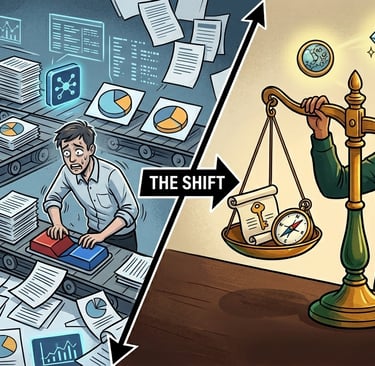
The Shift Nobody Is Saying Out Loud
The narrative is still:
“AI will replace jobs.”
That’s not what’s happening.
What’s actually happening is quieter.
AI is removing the need for average work.
Average research
Average writing
Average analysis
Not because AI is amazing.
Because it’s good enough.
And when “good enough” becomes instant, the value shifts.
If AI can do most of your job, your value becomes what it can’t do.
That’s judgment.
And most people haven’t trained it.
Output Is No Longer the Differentiator
There was a time when being the person who could:
build the deck
clean the data
write the doc
…made you valuable.
Now that’s baseline.
You can generate a strategy doc in minutes. You can spin up ideas endlessly. You can automate half your workflow in a weekend.
We’ve hit a weird place:
Everyone can produce. Very few can decide.
Even McKinsey & Company has been consistently pointing out that companies are increasing AI adoption, but struggling to turn it into real value:
👉 https://www.mckinsey.com/featured-insights/artificial-intelligence
That gap isn’t technical.
It’s operational.
The Hidden Trap: Mistaking Speed for Progress
AI makes you feel productive.
You generate more:
ideas
docs
outputs
Faster than ever.
But speed without direction creates a dangerous illusion:
progress without movement.
You’ll see teams:
shipping more content but not growing
building more dashboards but not deciding
running more experiments but learning nothing
Because they skipped the hard part:
deciding what actually matters.
AI didn’t create this problem.
It just made it easier to hide.
The New Bottleneck: Judgment
Here’s what AI doesn’t solve:
What problem actually matters
What “good” actually looks like
What tradeoffs to make
When something is done
That’s judgment.
And you can’t outsource it to a prompt.
This is why teams feel busy but stuck.
They have:
more tools
more output
more visibility
But fewer real decisions.
You see it everywhere:
AI-generated reports nobody uses
dashboards that don’t change behavior
strategies that never leave slides
I broke this down more bluntly here:
👉 https://sharpstarts.com/ai-agents-arent-failing-your-operations-are
AI isn’t failing.
Your system is.
Why Most People Are Falling Behind (Without Realizing It)
Most people think they’re adapting because they’re:
using AI daily
learning tools
moving faster
But they’re optimizing the wrong thing.
They’re getting faster at producing work that:
isn’t clearly scoped
isn’t tied to decisions
doesn’t drive outcomes
According to Gartner, a big chunk of AI efforts stall not because the tech fails, but because companies lack clarity on use cases and execution:
👉 https://www.gartner.com/en/topics/artificial-intelligence
That’s a judgment problem.
Not a tooling problem.
Where Operators Pull Ahead
The people winning right now aren’t AI experts.
They’re operators.
They know how work actually flows.
They can:
define the real problem
simplify messy inputs
connect tools into something usable
make calls without perfect data
AI just amplifies that.
If you don’t have those fundamentals, AI doesn’t make you better.
It just makes you faster at being wrong.
This is why tool stacking is quietly killing teams.
More tools → more noise → less clarity.
I went deeper on that here:
👉 https://sharpstarts.com/tool-sprawl-is-quietly-killing-startup-execution-and-most-teams-dont-notice
More tools don’t fix weak thinking.
They expose it.
The Operator Framework: Turning Output Into Decisions
If output is cheap, your edge is how you turn it into decisions.
Here’s the simplest version that actually works:
1. Define the Decision First
Before you open any AI tool, ask:
What decision am I trying to make?
If you can’t answer that, stop.
Everything after that is just noise.
2. Set a “Good Enough” Bar
AI gives you infinite options.
That’s the trap.
Decide what “done” looks like before you start.
Otherwise you’ll keep refining something that doesn’t matter.
3. Limit Inputs
More data feels smart.
It usually just slows you down.
Pick:
a few signals
a few metrics
a few constraints
Clarity beats completeness.
4. Force Output → Action
Every output should lead to:
a decision
a next step
or a kill
If it doesn’t, it’s just busy work.
This is the same thinking behind how I structure analytics systems:
👉 https://sharpstarts.com/from-dashboards-to-decisions-the-startup-analytics-stack-that-actually-drives-growth
Dashboards don’t matter.
Decisions do.
The Market Is Already Pricing This In
This shift is already happening.
Even Harvard Business Review has been writing about how AI is pushing work toward higher-level thinking and decision-making:
👉 https://hbr.org/topic/subject/artificial-intelligence
You can see it in hiring:
fewer entry-level roles
higher expectations per role
more hybrid “operator” roles
Companies don’t just want execution anymore.
They want people who can decide and execute.
What This Means for You
If you’re building, pivoting, or trying to stay relevant:
Don’t focus on being faster.
Focus on being clearer.
Work on:
defining problems properly
making decisions under uncertainty
designing simple workflows
understanding tradeoffs
That’s the layer AI doesn’t replace.
The Bottom Line
AI didn’t eliminate work.
It eliminated the value of undirected work.
Output is cheap.
Judgment is expensive.
And the people who build it will quietly outpace everyone else still optimizing for speed.
📚Further Reading
McKinsey Insights on Artificial Intelligence
→ Real-world breakdowns of where AI is actually creating value (and where it isn’t)Gartner Artificial Intelligence Research
→ Enterprise perspective on AI adoption, hype cycles, and execution gapsHarvard Business Review – AI Topic
→ How AI is reshaping knowledge work and decision-makingOECD AI Policy Observatory
→ Global view of AI’s impact on jobs, skills, and productivityMicrosoft Work Trend Index
→ How AI is changing how people work and make decisionsIBM Artificial Intelligence Hub
→ Enterprise AI use cases, adoption patterns, and implementation insights
TLDR
AI made output fast, cheap, and everywhere
That shifted the bottleneck to judgment
Most people are optimizing for speed, not decisions
More tools aren’t helping, they’re masking the problem
Operators who think clearly will quietly pull ahead