What the New Canada–U.S. Tariffs Mean for Startups, Founders, and Career Pivoters in 2026
The latest Canada–U.S. tariff announcements are creating uncertainty for businesses across North America. Learn what founders, operators, and career pivoters should actually do to stay resilient in 2026.
CAREERSTARTUPS
Alexander Pau
7/26/20269 min read
Why Everyone Is Talking About Tariffs Again
Over the past few weeks, it has been almost impossible to avoid headlines about new tariffs between Canada and the United States. News outlets have focused on negotiations, trade disputes, and the possibility of higher costs for businesses that rely on cross-border supply chains.
When I first read those headlines, my initial thought wasn't about politics.
It was about operations.
Every few years, a major event forces businesses to ask uncomfortable questions.
COVID-19 tested remote work.
Inflation tested pricing strategies.
Artificial intelligence is testing how knowledge work gets done.
Now tariffs are testing something different: how quickly organizations can adapt when the rules suddenly change.
It's easy to dismiss tariffs as something that only affects manufacturers or large corporations.
I don't think that's true.
If you're running a startup, working in operations, managing projects, or even planning your next career move, tariff uncertainty matters because it influences hiring decisions, technology investments, customer spending, and business confidence across entire industries.
The tariff itself may not directly affect your business.
The ripple effects probably will.
What the Latest Canada–U.S. Tariffs Actually Mean
Before discussing strategy, it's worth understanding what's happening.
Canada and the United States have one of the largest trading relationships in the world, with hundreds of billions of dollars in goods crossing the border every year. When either country introduces new tariffs or changes existing trade policies, businesses throughout the supply chain begin reassessing costs, pricing, sourcing, and investment decisions.
While the headlines often focus on steel, aluminum, automotive manufacturing, or agriculture, the impact rarely stops there.
Imagine a manufacturer paying more for imported components.
That manufacturer increases prices.
Its customers now face higher costs.
Some delay purchases.
Others reduce spending.
Technology projects get postponed.
Hiring slows.
Marketing budgets shrink.
Eventually, businesses that never imported a single product begin feeling the effects.
That's why organizations like the Government of Canada Trade Commissioner Service encourage Canadian businesses to diversify markets, understand international risks, and prepare for changing global trade conditions instead of relying too heavily on one trading partner.
The important takeaway isn't whether tariffs increase prices by 5% or 15%.
It's recognizing that uncertainty spreads much faster than tariffs themselves.
Why Startups Should Care (Even If They Don't Import Products)
One of the biggest misconceptions I hear is:
"We're a software company. Tariffs don't affect us."
Not directly.
Indirectly?
Quite a bit.
Let's say you're building a SaaS startup.
You don't manufacture anything.
You don't import inventory.
You don't own a warehouse.
You're probably thinking you're safe.
But what happens if your customers are manufacturers?
Or retailers?
Or logistics companies?
If their costs increase, their priorities change.
Projects that once felt urgent suddenly become optional.
Software upgrades get delayed.
Consulting engagements shrink.
Hiring freezes begin.
Your revenue doesn't disappear because of tariffs.
It slows because your customers become more cautious.
I've seen similar patterns during inflation, interest rate hikes, and economic slowdowns.
Businesses don't stop spending overnight.
They simply become more selective.
That makes operational efficiency even more important.
The companies that continue investing during uncertain periods usually aren't spending more.
They're spending smarter.
This is one reason I wrote The Founder's Recession Playbook for 2025. Economic uncertainty doesn't always create new problems—it often exposes the ones that already existed.
Internal Reading:
https://sharpstarts.com/the-founders-recession-playbook-for-2025-how-to-operate-when-the-market-is-pretending-everythings-fine
The Hidden Cost Most Businesses Overlook
When tariffs dominate the news, leadership teams naturally focus on rising costs.
That makes sense.
Costs are measurable.
Operational hesitation isn't.
One of the most expensive consequences of uncertainty isn't higher prices.
It's slower decisions.
I've watched organizations spend weeks waiting for more information before acting.
The problem is that perfect information almost never arrives.
Meanwhile, competitors are already making changes.
They're renegotiating supplier contracts.
They're reviewing technology budgets.
They're improving forecasting.
They're finding efficiencies.
The businesses that struggle during uncertain times usually aren't the ones hit hardest.
They're the ones that react the slowest.
That's why I believe every disruption—whether it's tariffs, inflation, AI, or regulation—is really an operational stress test.
It reveals how well your organization communicates, prioritizes, and executes under pressure.
As I've discussed in Governance Is the Hidden Operating System of Growth, companies rarely fail because people don't work hard.
They struggle because decisions become inconsistent when uncertainty increases.
Internal Reading:
https://sharpstarts.com/governance-is-the-hidden-operating-system-of-growth
Five Things Smart Operators Are Doing Right Now
One thing I've learned from working across startups, consulting, and business transformation is that uncertainty doesn't change what good operators do.
It simply exposes who has been doing it all along.
While some organizations are waiting for the next news cycle or hoping tariffs disappear, others are already making small improvements that will pay dividends regardless of what happens next.
Here are five practices I believe every founder and operator should prioritize.
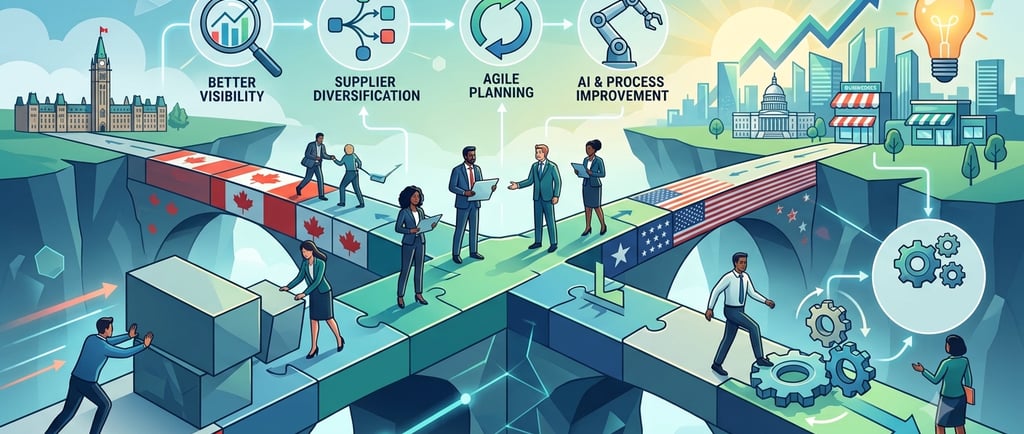
1. They Diversify Their Risks Before They Need To
It's easy to become dependent on a single supplier, customer, software platform, or revenue stream when business is growing.
Everything works—until it doesn't.
Tariffs are another reminder that concentrating too much risk in one area can quickly become expensive.
That doesn't mean every startup needs suppliers in five different countries.
It means understanding where your biggest dependencies exist and asking:
What happens if this supplier raises prices?
What if our biggest customer delays spending?
What if a critical software vendor changes pricing?
How quickly could we pivot?
Diversification isn't about eliminating risk.
It's about making sure one event doesn't stop your business from moving forward.
2. They Shorten Their Planning Cycles
For years, annual planning was considered best practice.
Today, markets change far too quickly.
The companies adapting fastest aren't necessarily creating better five-year plans.
They're reviewing assumptions more frequently.
Monthly operational reviews.
Quarterly strategic updates.
Regular retrospectives.
Instead of asking,
"Did we follow the plan?"
they ask,
"Is this still the right plan?"
That mindset makes organizations far more adaptable when external conditions change unexpectedly.
3. They Invest in Better Visibility
One of the biggest surprises I've seen inside organizations is how often leadership teams disagree—not because they have different opinions, but because they're looking at different data.
Finance reports one number.
Sales reports another.
Operations has a third.
Before long, leadership spends more time debating which numbers are correct than deciding what to do next.
During periods of uncertainty, visibility becomes a competitive advantage.
That doesn't mean building more dashboards.
It means building better ones.
The goal isn't more data.
The goal is trusted data.
As I discussed in From Dashboards to Decisions: The Startup Analytics Stack That Actually Drives Growth, dashboards should accelerate decisions—not create new debates.
Internal Reading:
https://sharpstarts.com/from-dashboards-to-decisions-the-startup-analytics-stack-that-actually-drives-growth
4. They Improve Processes Before Buying More Technology
Whenever costs rise, companies naturally start looking for tools that promise greater efficiency.
Today, that usually means AI.
Tomorrow, it'll be something else.
Technology absolutely has a role to play.
But I've learned that software rarely fixes operational confusion.
If approvals are inconsistent today, automation won't magically make them consistent tomorrow.
If documentation is incomplete, AI won't know which version of the process is correct.
The best technology investments usually happen after organizations simplify the work itself.
That's why process improvement often delivers a higher return than buying another platform.
5. They Treat Change as a Permanent Capability
This may be the biggest lesson tariffs have reinforced for me.
For years, businesses approached disruption as something temporary.
COVID was temporary.
Inflation was temporary.
Supply chain disruptions were temporary.
AI was another temporary challenge.
Now tariffs.
Eventually I stopped asking,
"When will things return to normal?"
Instead, I started asking,
"How can we become better at adapting?"
That small shift completely changes how an organization operates.
Instead of optimizing for stability, you're optimizing for resilience.
And resilience compounds.
Every improvement you make today helps you respond faster to the next disruption—whatever it happens to be.
Where AI Fits Into the Picture
Every discussion about rising costs eventually turns to AI.
Can AI reduce operating expenses?
Can it replace repetitive work?
Can it improve productivity?
The answer is yes.
But only if the foundation is already strong.
One mistake I see organizations make is treating AI like a shortcut.
They assume introducing an AI assistant will automatically improve efficiency.
Unfortunately, AI tends to magnify whatever already exists.
If your documentation is outdated, AI will reference outdated information.
If your processes are inconsistent, AI will automate inconsistency.
If your data is unreliable, AI will confidently produce unreliable recommendations.
According to McKinsey & Company, organizations creating the most value from AI combine technology investments with improvements in governance, operating models, and organizational change—not just software implementation.
That's why I believe operational maturity should come before AI maturity.
Document the process.
Improve the process.
Then automate the process.
If you're interested in going deeper, I explored this idea in AI Agents Aren't Failing. Your Operations Are, where I explain why successful AI projects usually begin with fixing workflows—not writing better prompts.
Internal Reading:
https://sharpstarts.com/ai-agents-arent-failing-your-operations-are
What This Means for Your Career
Even if you don't own a startup, these lessons still apply.
Economic uncertainty changes hiring behavior.
Companies become more selective.
Budgets tighten.
Projects receive greater scrutiny.
When that happens, employers naturally look for people who reduce uncertainty rather than create more of it.
The professionals who continue growing during uncertain periods aren't necessarily experts in every new tool.
They're the people who can:
solve ambiguous problems
improve business processes
communicate across teams
interpret data
learn quickly
adapt when priorities shift
These are durable skills.
The software will change.
The headlines will change.
The technology will change.
Operational thinking won't.
That's one reason I'm optimistic about professionals who invest in business analysis, project management, process improvement, and AI literacy together.
Those skills complement each other regardless of what the economy is doing.
Key Takeaways
Tariffs are creating uncertainty, but uncertainty is becoming a permanent feature of modern business.
The biggest business risk often isn't higher costs—it's slower decision-making.
Companies with documented processes, trusted data, and shorter planning cycles adapt more effectively.
AI delivers the greatest value when paired with strong operations and governance.
Whether you're building a company or your career, resilience is becoming a greater competitive advantage than efficiency alone.
Frequently Asked Questions
What are tariffs?
Tariffs are taxes imposed on imported goods. They can increase costs for businesses importing products or materials and may influence pricing, supply chains, and consumer demand.
Why do Canada–U.S. tariffs matter?
Canada and the United States are each other's largest trading partners in many sectors. Changes to tariffs can ripple through manufacturing, logistics, retail, technology, and professional services—even for businesses that don't import products directly.
How can startups prepare for tariff uncertainty?
Startups should focus on improving operational resilience by reviewing supplier dependencies, building multiple planning scenarios, strengthening cash flow management, documenting processes, and investing in reliable business data.
Will software companies be affected by tariffs?
Indirectly, yes. While software companies may not import physical goods, many of their customers operate in industries affected by tariffs. If those customers reduce spending or delay projects, software businesses can feel the impact.
Should businesses invest in AI during periods of uncertainty?
AI can improve productivity and reduce costs, but it works best when built on strong operational foundations. Companies should simplify workflows, improve data quality, and clarify governance before scaling AI initiatives.
Conclusion
Every few years, a different headline dominates the business world.
One year it's inflation.
The next it's artificial intelligence.
Today, it's tariffs.
The headline changes.
The lesson doesn't.
Businesses that thrive aren't the ones that perfectly predict economic policy or geopolitical events.
They're the ones that build organizations capable of adapting no matter what happens next.
That's why I don't see tariffs as just another trade story.
I see them as a reminder that resilience has become a business capability—not a contingency plan.
For founders, operators, and career pivoters alike, the question isn't whether another disruption is coming.
It almost certainly is.
The real question is whether your business—or your career—will be ready when it arrives.
📚Further Reading
1. Government of Canada Trade Commissioner Service
Helping Canadian businesses compete globally
A practical resource for Canadian founders and companies looking to understand international markets, export opportunities, and changing trade conditions.
Making better decisions when the future is uncertain
Research and analysis on leadership, strategy, scenario planning, and organizational resilience.
How businesses are capturing value from AI
Insights into why successful AI adoption depends on business transformation, governance, and process redesign.
4. OECD Trade and Agriculture Directorate
Understanding global trade shifts
Research and analysis on international trade patterns, supply chains, and economic policy changes.
5. World Economic Forum Reports
Global risks shaping business strategy
Reports covering geopolitical uncertainty, technology disruption, workforce changes, and economic trends.
Building organizations that adapt faster
Research on operational resilience, digital transformation, AI adoption, and business agility.
TL;DR
New Canada–U.S. tariff announcements are creating uncertainty for businesses, but uncertainty affects far more than manufacturers.
Rising costs often expose weaknesses in operations, planning, and decision-making rather than causing them.
Startups that improve processes, diversify suppliers, and shorten planning cycles will adapt faster than those waiting for certainty.
AI can help offset rising costs, but only when built on reliable processes and clean data.
Whether you're a founder or a career pivoter, operational thinking is becoming one of the most valuable skills you can develop.